Payment Gateway North Macedonia: how online card payments actually work
A practical guide to the complete card-payment flow and how Kordiva connects checkout, Stripe-powered payments, orders and operations.
- Published:
- Updated:
- Author
- Kordiva Editorial Team
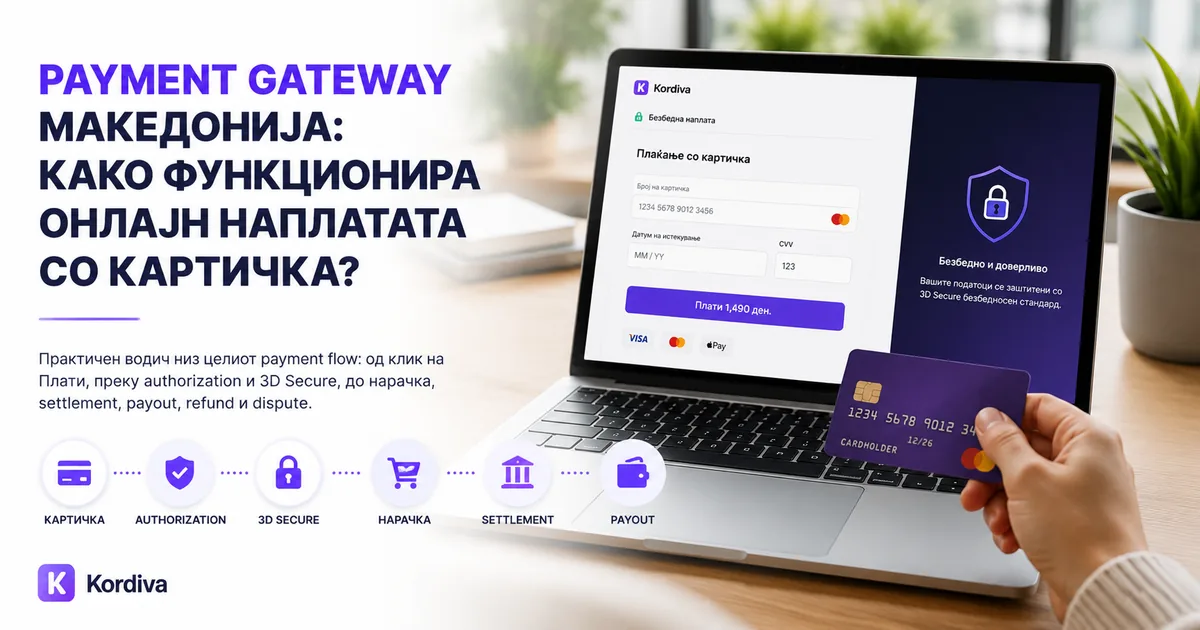
When a customer enters a card and presses Pay, the screen makes it look like one operation. In reality, checkout, the payment provider, acquiring infrastructure, the card network and the issuing bank exchange information within seconds.
That is why a payment gateway should not be judged by transaction fee alone. The merchant needs to understand supported markets and cards, authentication, risk, refunds, disputes, currencies and—most importantly—how payment status becomes an actionable order.
What is a payment gateway?
A payment gateway is part of the infrastructure that securely transmits the information required to initiate payment authorization. Modern providers can combine gateway, processing, acquiring and other payment services behind one integration layer.
For an ecommerce business, the useful operational questions are whether payment succeeded, which order it belongs to, whether authentication is required, when funds become available and what happens when a refund or dispute appears later.
What happens after the customer presses Pay?
1. Checkout
The store prepares the amount, currency and order context and starts the secure payment flow.
2. Payment provider
The payment infrastructure handles the required payment information without the store unnecessarily storing sensitive card data.
3. Card network and issuer
The authorization request reaches the issuing bank through the relevant network, and the issuer decides whether to approve or decline it.
4. Authentication
When required, the customer completes an additional step such as 3D Secure.
5. Payment status
The result returns to the commerce system and must be linked to the correct order. A browser redirect to a success page alone should not drive backend fulfilment.
6. Settlement and payout
After successful payment, settlement and payout follow according to the applicable provider setup, currency, risk controls and schedule.
3D Secure, fraud and why a valid card can still be declined
A decline does not automatically mean the customer lacks funds or that the store is suspicious. The issuer can decline based on authentication, card restrictions, incorrect details, its own risk rules or other signals. 3D Secure adds another authentication layer when required.
A foreign card is not automatically treated as spam because the merchant is based in the Balkans. Cross-border authorization can have a different risk profile, but the outcome depends on multiple participants and signals across the payment chain.
Local bank gateway or global payment provider?
A local gateway can be an excellent fit for a business focused on its domestic market. A merchant planning multiple markets, currencies and cross-border cards should also compare acquiring coverage, developer tooling, risk controls, refunds, disputes and operational visibility.
There is no universally superior provider. The right infrastructure depends on the business model. Kordiva's position is therefore not that local banks are bad; the question is whether the payment and commerce architecture fits where the business intends to sell.
Payment success is not the end of an order
A successful payment should trigger an organized process: correct order status, inventory changes where applicable, fulfilment work, customer confirmation and a traceable path for a later refund or dispute.
A payment confirmation, order confirmation, invoice and fiscal receipt are not interchangeable documents. The merchant must apply the appropriate North Macedonian fiscal and business-document rules for its transaction model.
How Kordiva connects payment with the complete commerce flow
Kordiva is the commerce layer around the payment. A merchant can use a professional Next.js storefront, checkout links for social selling or an API integration for an existing website, while products, variants, inventory, orders and operations remain connected through the CMS.
Kordiva commerce flow
Next.js Store / Checkout Link / API → Checkout → Stripe-powered Payment → Order → Operations → Payout / Refund / Dispute
For supported registered businesses in North Macedonia, Kordiva connects merchants to Stripe Connect onboarding. Stripe performs its own verification and makes its own eligibility decision; Kordiva cannot guarantee Stripe approval. Kordiva also applies its own compliance and risk policy to the organizations, products and business models permitted on the platform.
Kordiva is also preparing local e-Invoice integration around the Public Revenue Office system. Until the official production interfaces and rollout are available, this should not be represented as a completed production government integration.
Sources
- Stripe Payments — Stripe
- 3D Secure — Stripe
- Stripe global availability — Stripe
- Fiscalization — Public Revenue Office
Next step with Kordiva
Continue reading
Online store with Stripe in North Macedonia
Understand Stripe availability in North Macedonia and how Kordiva connects eligible businesses to Stripe Connect onboarding and a complete commerce workflow.
Local bank or global payment provider?
The real choice is not local versus global. It is which payment and commerce architecture fits your customers, markets and operations.
Best ecommerce platform for an online store in North Macedonia
The storefront is only the beginning. Compare Kordiva, Shopify, WooCommerce and BigCommerce by how well they connect the complete path from sales channel to order operations.
Payments are only one part of the ecommerce process
See how Kordiva connects the storefront, checkout, payment, order and day-to-day operations in one system.
See what Kordiva is