Local bank or global payment provider?
The real choice is not local versus global. It is which payment and commerce architecture fits your customers, markets and operations.
- Published:
- Updated:
- Author
- Kordiva Editorial Team
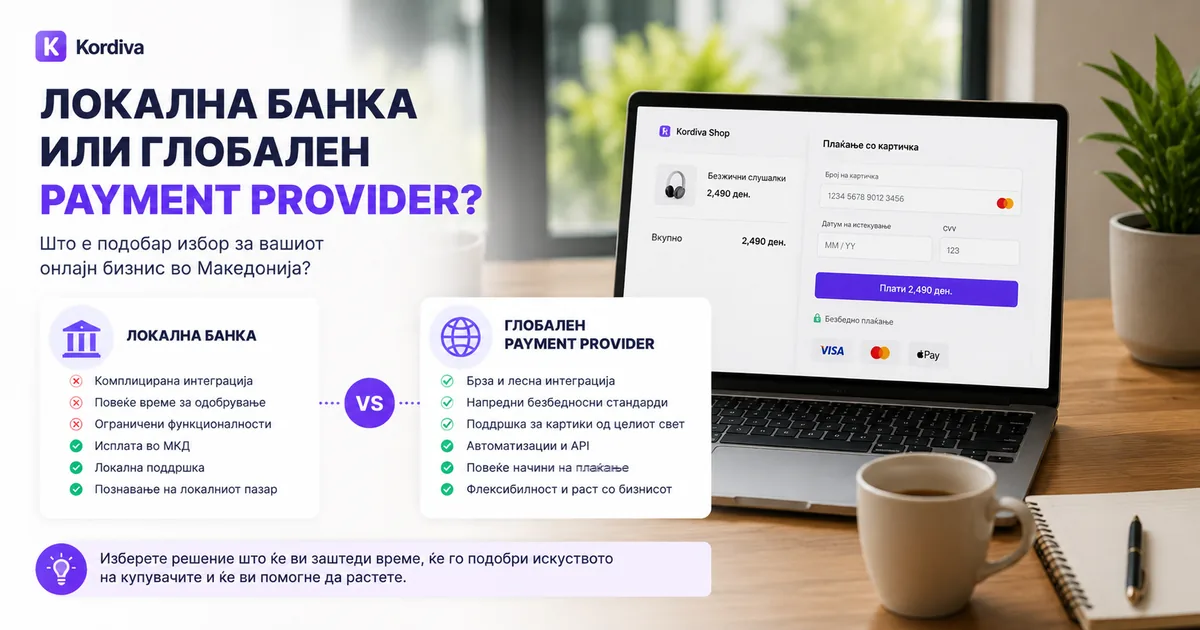
A “Pay by card” button does not automatically make an online store ready for international commerce. A local bank gateway can be an excellent solution for a business focused on domestic customers. As the business expands into other countries and currencies, however, the payment and operational requirements become broader.
The useful comparison is therefore not “local bank versus global provider” as if one side were always better. Compare the actual job the infrastructure must perform: authorization, currencies, risk, refunds, disputes, payouts and the connection between payment and the rest of the order workflow.
Card checkout is only one part of the system
Behind a simple checkout sit merchant verification, payment authorization, risk controls, order confirmation, settlement, payout, refunds and possible disputes. Two stores can therefore look identical to a customer while relying on very different infrastructure behind the screen.
A foreign card is not automatically treated as spam because a store is based in the Balkans. Approval depends on the issuer, merchant and acquirer setup, authentication, risk signals and the rules applying to the particular card and transaction.
When a local bank gateway can be the right choice
If most customers, delivery and payments are domestic, a local gateway can be practical and entirely appropriate. Depending on the bank or acquirer agreement, foreign-issued cards may also be supported.
Ask where your customers are today, where you intend to sell tomorrow, which currencies matter, what payout and refund processes you need and how much integration and maintenance your team wants to own.
What changes when you sell beyond your home market
Cross-border selling can introduce different currencies, issuer rules, FX, authentication and risk patterns. Refunds and disputes must still remain connected to the original payment and order. Global payment infrastructure is designed to handle a broader set of these flows across markets.
A payment gateway is not a complete ecommerce platform
This distinction matters. A merchant does not merely need to charge a card. Products must be presented, inventory maintained, checkout completed, orders recorded, payments reconciled, fulfilment organized and customer issues handled.
A real ecommerce flow looks like this:
Sales channel → Product → Checkout → Payment → Order → Operations → Refund / support → Business records
Where Kordiva fits
Kordiva is built around that wider commerce job. A merchant can launch a professional Next.js storefront, create checkout links for customers coming from social channels, or connect an existing frontend through the API. Those paths can feed the same products, orders and operations instead of creating separate manual workflows.
For supported registered businesses, Kordiva connects Stripe-powered payments through Stripe Connect onboarding. Stripe performs its own verification and makes its own eligibility decision. Kordiva separately applies its compliance and risk policy to organizations, products and business models using the platform.
That positioning is deliberately broader than “we offer Stripe.” The payment provider handles payment infrastructure; Kordiva's job is to connect the sales channel, checkout, payment, order and daily commerce operations into one workflow.
Example: a Macedonian brand that wants to sell in Germany
Imagine a manufacturer in Skopje with 20 domestic orders per month that wants to test Germany. The first question should not be which plugin to install. It should verify business and product eligibility, pricing and currencies, payment flow, refunds, fulfilment and the tax and consumer obligations that apply to the sale.
Kordiva can simplify the technical commerce layer—storefront, CMS, checkout, orders, payment operations, checkout links and API—but it does not replace the merchant's legal, tax, customs or logistics obligations. Good infrastructure makes those responsibilities easier to operate rather than pretending one button removes them.
Sources
- Stripe global availability — Stripe
- Global acquiring 101 — Stripe
- Stripe Payments — Stripe
- Stripe Macedonia — Kordiva
Next step with Kordiva
Continue reading
Payment Gateway North Macedonia: how online card payments actually work
A practical guide to the complete card-payment flow and how Kordiva connects checkout, Stripe-powered payments, orders and operations.
Online store with Stripe in North Macedonia
Understand Stripe availability in North Macedonia and how Kordiva connects eligible businesses to Stripe Connect onboarding and a complete commerce workflow.
Best ecommerce platform for an online store in North Macedonia
The storefront is only the beginning. Compare Kordiva, Shopify, WooCommerce and BigCommerce by how well they connect the complete path from sales channel to order operations.
Payments are only one part of the ecommerce process
See how Kordiva connects the storefront, checkout, payment, order and day-to-day operations in one system.
See what Kordiva is