How to open an online store in North Macedonia
A practical start-to-launch ecommerce guide: define the business, register the merchant, build the catalog, connect checkout and payments, test operations and only then scale traffic.
- Published:
- Updated:
- Author
- Kordiva Editorial Team
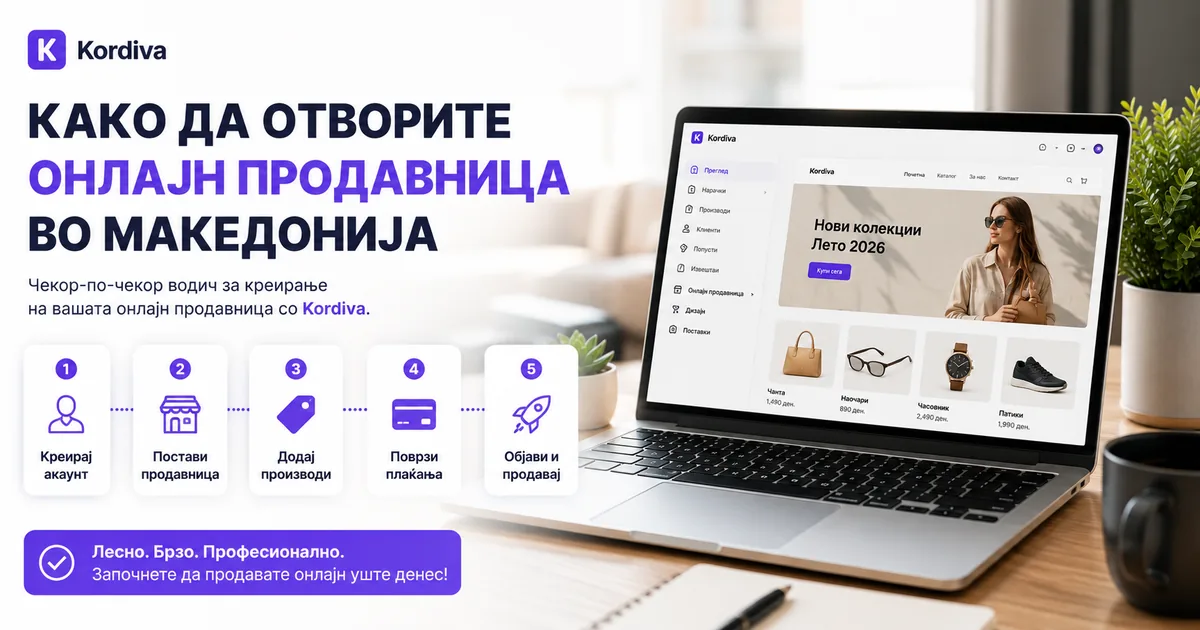
An online store is not simply a website with products. It is a connected process for presenting an offer, taking an order, accepting payment, fulfilling the purchase, communicating with the customer and maintaining the required business records. The strongest launch plan starts with that complete process rather than with a theme.
1. Define the business before building the store
Write down what you sell, who buys it, where you deliver and who fulfils each order. Physical goods, digital products and services have different requirements for inventory, delivery, returns and payment-provider eligibility.
Calculate the selling price together with tax, payment costs, packaging, delivery, expected returns and marketing. A store can look excellent and still fail if the economics of each order do not work.
2. Establish the merchant and its obligations
For Kordiva merchant access, the seller must be a registered legal entity or registered sole trader with accurate business information. Confirm the appropriate legal, tax, fiscal and accounting setup with the relevant authorities and qualified advisers for your activity.
Your customer-facing pages should identify the seller and explain contact methods, delivery, cancellation, returns, privacy and sales terms. Those policies should describe the process the business can actually fulfil.
3. Build the sales channel and catalog
Kordiva gives a business three practical entry points: a complete Next.js storefront, a direct checkout link that can be shared through social channels, or an API integration behind an existing website. The point is not to force every merchant into the same frontend; it is to connect different sales channels to the same commerce operations.
Build a small, accurate catalog first. Use clear names, original descriptions, correct prices, useful images, availability, variants and categories that match how customers search.
4. Connect checkout, payments and fulfilment
For supported businesses using Stripe-powered payments, Kordiva connects the merchant to Stripe Connect onboarding. Stripe performs its own verification and determines Stripe eligibility; Kordiva does not guarantee approval. Kordiva separately applies its own compliance and risk policy to the organizations, products and business models allowed on the platform.
For delivery, define zones, prices, free-delivery thresholds, expected timing and what happens when a shipment fails. The customer should understand the total price and delivery method before confirming the order.
Think in one flow
Store / Checkout Link / API → Checkout → Payment → Order → Operations → Fulfilment → Refund / Support
5. Test the complete journey before buying traffic
Run the process on mobile and desktop. Find a product, select a variant, complete checkout, verify the order and payment status, confirm inventory behavior, customer email, fulfilment workflow, required documents and the refund path.
Then launch with a controlled catalog and watch where customers hesitate or leave. The objective is not merely to publish a website. It is to build a commerce process that can keep working when five orders become fifty.
Sources
- Central Registry of the Republic of North Macedonia — Central Registry
- Public Revenue Office — UJP
- Kordiva features — Kordiva
Next step with Kordiva
Continue reading
Best ecommerce platform for an online store in North Macedonia
The storefront is only the beginning. Compare Kordiva, Shopify, WooCommerce and BigCommerce by how well they connect the complete path from sales channel to order operations.
What is Kordiva?
Kordiva is an ecommerce platform built for Macedonian businesses that want to start selling online and manage their store, payments, products and orders from one place.
Do you need a registered business to sell online in North Macedonia?
An Instagram profile is not the same as a verified merchant. Learn when registration matters, what payment systems verify and how professional ecommerce onboarding works with Kordiva.
Move from the guide to a concrete ecommerce setup
See how ecommerce approaches compare and which parts of the sales process your platform needs to solve.
Compare ecommerce platforms